Scientific AI
Hybrid retrieval, structured databases, knowledge graphs, and agentic LLM workflows for battery science and materials discovery.
Stanford · SLAC · AI for Science · Energy Security
I am a Stanford Mechanical Engineering PhD Candidate and AI-for-science researcher at the SLAC–Stanford Battery Center, building evidence-grounded systems for battery diagnostics, critical-materials discovery, climate-resilient infrastructure, and technology policy.
What I do
My work spans the full technology stack: from physical materials and experimental data, to AI systems and supply chains, to institutions and communities where implementation succeeds or fails.
Hybrid retrieval, structured databases, knowledge graphs, and agentic LLM workflows for battery science and materials discovery.
Batteries, Raman spectroscopy, hBN interfaces, REBCO superconductors, fusion magnets, and rare-earth-efficient materials.
Critical-minerals strategy, Chinese semiconductor industrial policy, Indo-Pacific energy security, and U.S. technology leadership.
Clean water, climate resilience, STEM education, accessibility advocacy, youth entrepreneurship, and field-driven design.
Academic & science research
My current work is centered on scientific decision infrastructure: systems that help researchers convert noisy, high-throughput experimental data and fragmented literature into interpretable, evidence-backed scientific action.

Flagship project
A hybrid retrieval-augmented conversational assistant for battery science.
SpectraQuery links structured operando Raman databases with scientific literature, translating natural-language questions into coordinated SQL and retrieval operations. The goal is not a generic chatbot; it is an evidence-grounded scientific reasoning layer that helps battery scientists interrogate data, mechanism, and uncertainty in seconds.
AI infrastructure for rare-earth-efficient magnet discovery, linking materials databases, scientific literature, knowledge graphs, manufacturability constraints, and uncertainty-aware candidate downselection.
See critical materials strategyInvited advisor to a White House Quad initiative on critical minerals and climate, contributing technical-policy analysis on resilient clean-energy supply chains, clean-energy investment, and Indo-Pacific energy security.
See policy workAdvisory work to the U.S. State Department project in Guyana, translating field and stakeholder discovery into ARK: an AI-enabled automated koker concept for flood mitigation and coastal agricultural resilience.
See global implementationResearch with The Economist’s Beijing bureau on China’s semiconductor industrial strategy, integrating interviews, policy documents, industrial datasets, and U.S.–China technology-competition analysis.
See diplomacy & policyPro bono environmental-policy and clean-energy analysis for Nevada Tribal Nations, bridging tribal sovereignty, federal energy policy, climate finance, and practical deployment strategy.
See climate & service workPhysics-informed ML pipelines for operando battery spectroscopy: baseline correction, denoising, Bayesian peak fitting, spatial-temporal heterogeneity, and multimodal electrochemical analysis.
SLAC Battery CenterExperimental battery-materials work on hBN and mica-inspired interfacial strategies for dendrite suppression, hydrogen-evolution mitigation, and stable electrochemical interfaces.
Discuss collaborationCharacterization workflows for high-temperature superconducting tapes used in high-field fusion magnets, reducing bottlenecks in materials screening for commercial fusion scale-up.
Related public profileComputational and machine-learning-assisted design of lower-cost magnetic structures for modular fusion concepts using permanent magnets rather than complex superconducting electromagnets.
Request detailsLow-cost solar water purification work developed with attention to local policy, resource constraints, community needs, and the long shadow of extraction.
Global implementationHousehold water purification and desalination solutions adapted to local material availability, maintenance realities, and women-centered implementation models.
See global workA low-cost, reusable microfluidics platform to rapidly measure bacterial contamination in drinking water for rural communities and refugee-camp settings.
Request paperA paper-based diagnostic concept for low-volume blood samples, designed for pregnancy-related anemia screening and field health workers in underserved settings.
Request detailsDiplomacy & international policy
My policy work sits at the edge of energy security and international relations: how nations build resilient technology systems, how scientific innovation is shaped by geopolitics, and how democratic societies can lead in critical materials without losing sight of human stakes.
Invited advisor to a White House Quad initiative on critical minerals and climate, contributing technical-policy analysis on Indo-Pacific energy security, supply chains, and clean-energy manufacturing.
Researched China’s semiconductor industrial policy through interviews, datasets, policy documents, and comparative political-economy analysis during escalating U.S.–China technology competition.
Helped lead technical strategy for ARK, an AI-enabled automated koker system for flood mitigation and coastal agricultural resilience, built from extensive field and stakeholder discovery.
Global service, education & humanitarian technology
From water systems to youth entrepreneurship to STEM education, my global work has taught me that durable innovation is local, relational, and often built far from the rooms where policy is written.
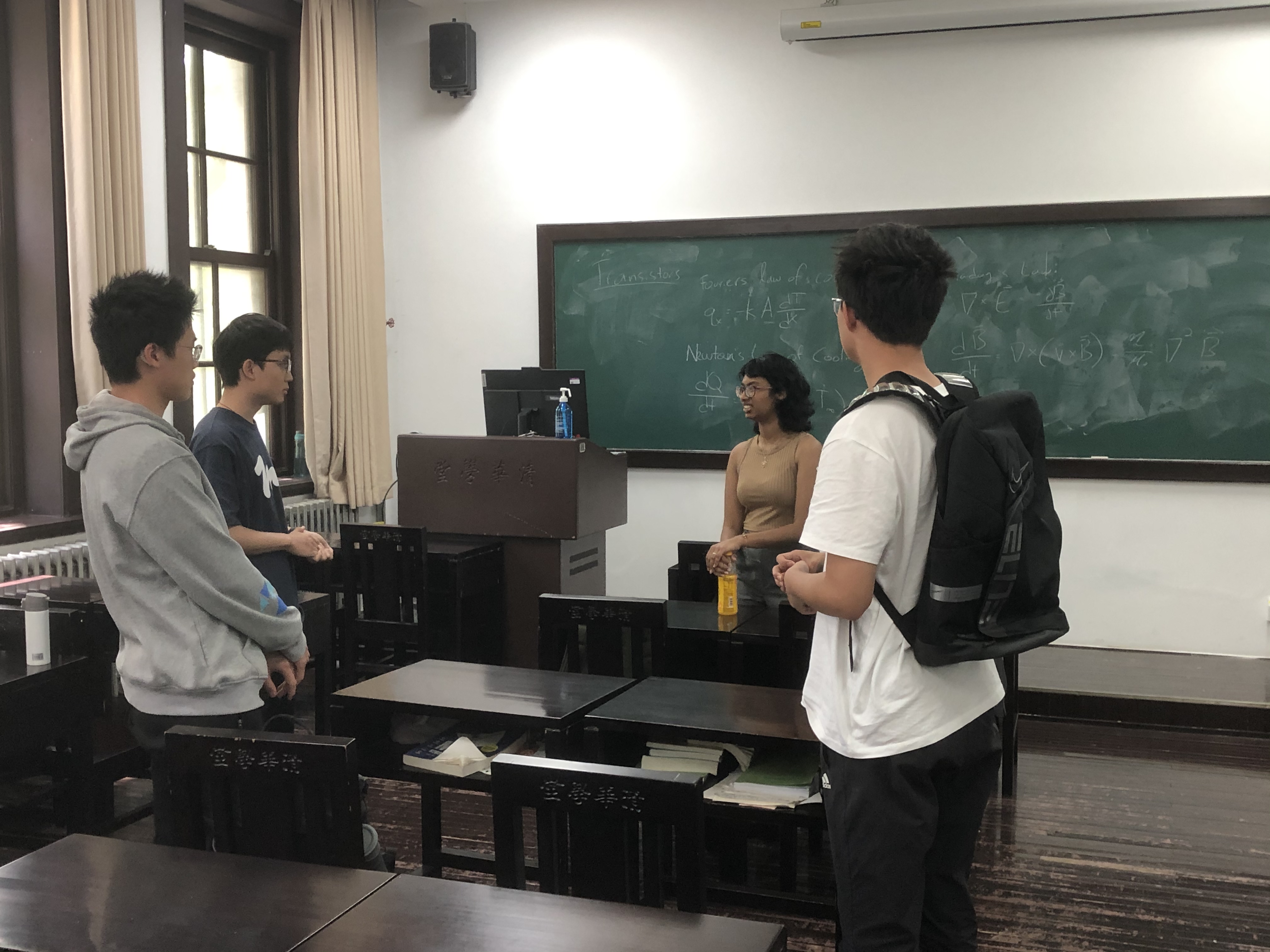
Solar desalination, rainwater harvesting, local service models, and community-informed maintenance.
Mentored Israeli and Palestinian students building startups in Jerusalem through MEET.
Robotics, web design, cybersecurity, aerospace sensors, and technology as a language for cooperation.
Clean-energy transition planning, climate-resilient infrastructure, and data-driven curricula for underserved learners.
Synapse National, MIT Medical Board work, inclusive education, free menstrual products, student support, and institutional advocacy.
Education & honors
PhD Candidate, Mechanical Engineering. Knight-Hennessy Scholar, NSF Graduate Research Fellow, Quad Fellow, Stanford EDGE Fellow. Current research at Stanford/SLAC on scientific AI for energy materials.
MMSc in Global Affairs as a Schwarzman Scholar and PepsiCo Foundation Henry M. Paulson, Jr. Fellow. Capstone research with The Economist, Beijing, on Chinese semiconductor industrial policy.
BS in Mechanical Engineering and BS in Electrical Engineering & Computer Science. MIT Henry Ford II Scholar, Rhodes Finalist, Tau Beta Pi, Pi Tau Sigma, Eta Kappa Nu.
Industry & engineering breadth
Python tooling and enterprise ML infrastructure, including open-source pipeline integrations.
View GitHub repoLow-latency C++ components for proprietary trading systems, signal generation, and backtesting workflows.
NLP moderation models and MLflow workflows for large-scale conversation moderation.
Nanomechanical and plasmonic systems research resulting in ACS Photonics publication history.
Robotics and satellite-servicing technology foundations before university.
View GitHub repoRoad-network planning algorithms for self-driving vehicle systems.
Writing, speaking & public scholarship
I write about AI, energy, democracy, technology policy, scientific infrastructure, and the human realities behind physical systems.
Read SubstackMRS Energy & Sustainability review on machine-learning-driven battery research.
Read articlearXiv preprint on hybrid retrieval-augmented conversational assistance for battery science.
Read preprintStanford International Policy Review article on global critical-minerals shortcomings and cooperation.
Read policy articleCollaborate
I am interested in scientific AI for real laboratories, critical-materials discovery, battery diagnostics, technology policy, climate adaptation, and startups that turn technical depth into public-scale impact.